Tehos
BackTehos art - street art - Collage art 2017 - 2019
Tehos art - street art - Collage art 2017 - 2019 In the Silhouettes series, Tehos exposes a central paradox of contemporary visual culture: the more society produces images of the individual, the more that individual seems to dissolve. Starting from street photographs of anonymous passersby, he reduces these figures to flat black shapes, almost formless, performing a negation of portraiture itself. The human figure becomes absence. These emptied silhouettes stand before a world saturated with1
Tehos art - street art - Collage art 2017 - 2019
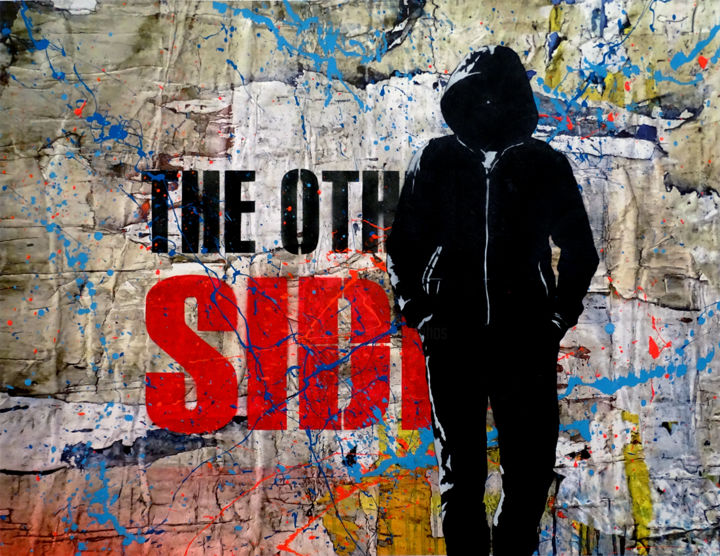
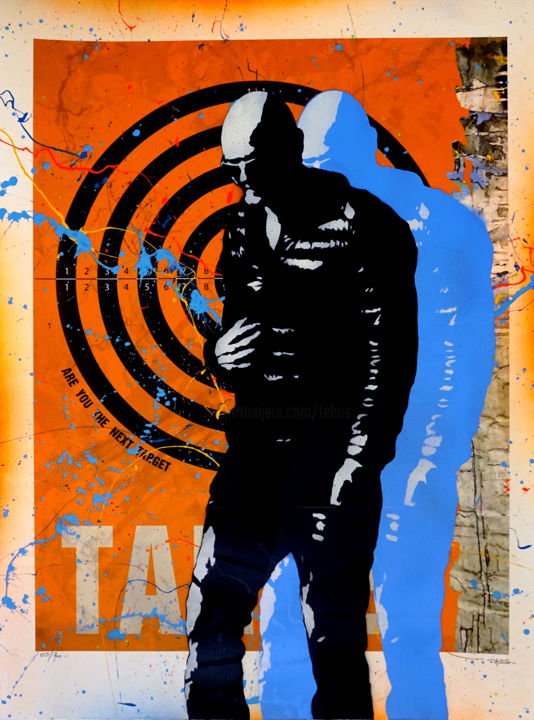
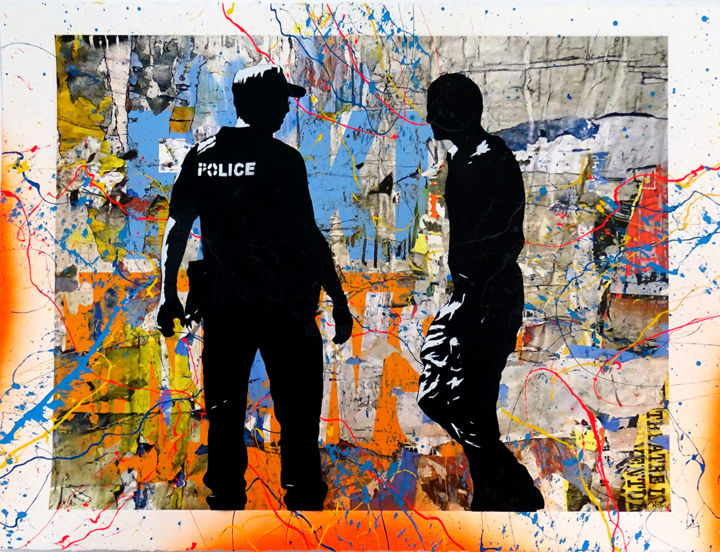
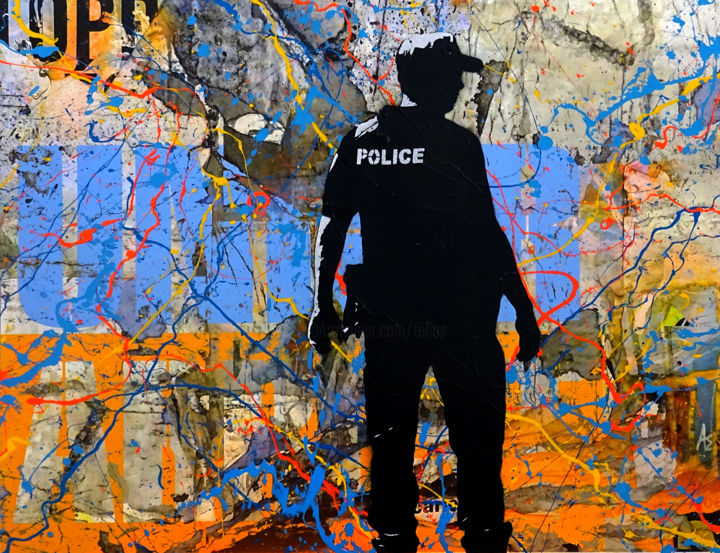
In the Silhouettes series, Tehos exposes a central paradox of contemporary visual culture: the more society produces images of the individual, the more that individual seems to dissolve. Starting from street photographs of anonymous passersby, he reduces these figures to flat black shapes, almost formless, performing a negation of portraiture itself. The human figure becomes absence.
These emptied silhouettes stand before a world saturated with signs: torn posters, graffiti, urban textures, aggressive colors. This loud visual environment never meets the subject, and the collage is not decorative but symptomatic — a surface speaking too loudly for any individual to inhabit it.
Where art history has either celebrated the subject or absorbed it into social critique — from Warhol to Barbara Kruger — Tehos presents a being already missing, a silent remnant available to any projection. The slogans (“This is your life,” “Market target”) no longer address anyone; they are fragments of a language without a recipient.
The work does not ask us to look at the silhouette but to perceive what is absent from it: gaze, story, density. It becomes an empty interface, a site where the person fails to materialize. In this sense, the series anticipates several of Tehos’s core concerns: the erasure of the figure, the pressure of visual systems, the fragility of identity, and the reduction of the subject to a surface.
In the lineage of the “hollow subject” — from Boltanski’s shadows to Kara Walker’s cutouts — Tehos offers a drier, almost administrative version of disappearance. The silhouette is not a symbol of absence; it is absence — precise, graphic, incontestable — in a world that continues speaking to it nonetheless.
In the Silhouettes series, Tehos exposes a central paradox of contemporary visual culture: the more society produces images of the individual, the more that individual seems to dissolve. Starting from street photographs of anonymous passersby, he reduces these figures to flat black shapes, almost formless, performing a negation of portraiture itself. The human figure becomes absence.
These emptied silhouettes stand before a world saturated with signs: torn posters, graffiti, urban textures, aggressive colors. This loud visual environment never meets the subject, and the collage is not decorative but symptomatic — a surface speaking too loudly for any individual to inhabit it.
Where art history has either celebrated the subject or absorbed it into social critique — from Warhol to Barbara Kruger — Tehos presents a being already missing, a silent remnant available to any projection. The slogans (“This is your life,” “Market target”) no longer address anyone; they are fragments of a language without a recipient.
The work does not ask us to look at the silhouette but to perceive what is absent from it: gaze, story, density. It becomes an empty interface, a site where the person fails to materialize. In this sense, the series anticipates several of Tehos’s core concerns: the erasure of the figure, the pressure of visual systems, the fragility of identity, and the reduction of the subject to a surface.
In the lineage of the “hollow subject” — from Boltanski’s shadows to Kara Walker’s cutouts — Tehos offers a drier, almost administrative version of disappearance. The silhouette is not a symbol of absence; it is absence — precise, graphic, incontestable — in a world that continues speaking to it nonetheless.
Download